Arbital Health Senior Advisor Dr. Ian Duncan, FSA, MAAA, on his priorities for the Society of Actuaries, why value-based care is so hard to scale, and where he hopes health actuaries go next.
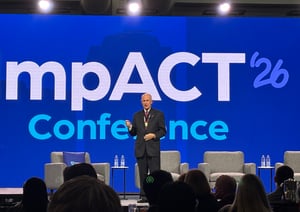 This week, Dr. Ian Duncan was inducted as President and Chair of the Society of Actuaries (SOA) at the annual SOA ImpACT Conference. It caps a career that began in London in 1976 and has since spanned life insurance, health care, academia, and three analytics companies he founded or co-founded. The most recent, Santa Barbara Actuaries (SBA), was acquired by Arbital Health in January 2024, and Ian now serves as a Senior Advisor to our team.
We sat down with Ian ahead of his induction to talk about his plans for the SOA, the problem SBA set out to solve, what keeps value-based care from working at scale, and how he sees AI reshaping the profession.
From life insurance to health care
What first drew you to health care actuarial work?
“I started my career in London about 50 years ago as a life insurance actuary, and in the UK there was very little health insurance work for actuaries to do. I moved to Canada, still in life insurance, at a company that rotated its actuaries through different lines of business. After two years they moved me into health, and at first I wasn't particularly happy about it. Over time, though, I came to see how important the work is and how much I enjoyed it. So I didn't choose health. Health chose me.”
Priorities as SOA President
What does becoming President of the SOA mean to you, and what will you focus on?
“I've volunteered with the Society of Actuaries for almost 30 years, on a number of committees and on the board. On a personal level it's been very rewarding. You meet people, you get to do new things, and I've had the chance to travel the world because of it.
More important than that, it's a chance to influence the direction of the profession. I think it's more important than ever for actuaries to take a hard look at where the profession is going and get involved in moving it forward.
The SOA has a three-year strategy built around three things. The first is growing the pipeline of both young and experienced actuaries.
The second is international growth. The SOA has about 36,000 members and, at any one time, roughly 40,000 candidates taking exams, so about 76,000 people in total. Around 20% of them live outside North America, and about 30% of our new exam takers come from Asia. As president-elect I've visited actuaries, universities, and conferences in Africa, Asia, and India. The way actuaries are credentialed and educated differs from country to country, so the support our members need there differs from what we provide in North America.
The third is AI, and we're still working out how it will affect the profession. As an educator, one of my concerns is that AI may reduce the number of entry-level jobs, as it is in many fields in today’s AI boom. I'm encouraging the SOA to move more practical training into universities, so students graduate with practical as well as theoretical knowledge. That makes them more employable, because employers no longer have to provide that first-year experience themselves.
Beyond the strategy, my personal campaign for the coming year is entrepreneurship. We face real pressure from outside and if the profession is going to grow and thrive, actuaries need to become greater risk takers and take strong leadership positions in the field.”
Building Santa Barbara Actuaries
What problem were you trying to solve when you started Santa Barbara Actuaries?
“SBA was the third company of its type that I founded or co-founded. We originally set out to do what my earlier companies had done, which was a combination of predictive analytics and evaluating care programs.
Between selling my previous company in 2008 and starting SBA in 2015 alongside Andrew Mackenzie, the industry shifted. Insurers and health plans had carried most of the risk and hired outside companies to manage their high-risk patients. Then the message became, "providers need to take risk," and that became value-based contracting. We didn't start the company to do value-based contracting. It was simply growing at the time, and I knew how to work with providers and measure the economic outcomes of programs. So we built a business around identifying high-risk patients and evaluating whether interventions actually produced a positive outcome.”
Why did joining Arbital feel like the right next step?
“I've been an actuary for 50 years now, and there comes a point when you need to pull back a little. I had also decided to run for SOA president, so I knew I'd be busy.
I could also see where the field was heading. Actuarial work was moving toward automation and advanced technology, and I wanted what we’d built at SBA to be part of that. We had been building a platform, and we needed two things to finish the job: more capital and deeper software expertise. Arbital brought both. It was the right move for the business, and it let me take my career a little more slowly and do other things, like serve as president.”
What makes Arbital's approach different from how actuarial work has traditionally been done?
“Actuaries are trained essentially as ‘craftsmen’. Give them a problem and they'll solve it from first principles. Because of that, there's far less automation in actuarial work than in most other disciplines. Actuaries would rather build the answer themselves, very often in Excel, than rely on software.
Arbital standardizes value-based contracting on a platform that automates many actuarial functions. That's a very different approach. What SBA started and Arbital is carrying forward is bringing to actuarial work the same kind of automation other industries have relied on for years.”
Why value-based care is hard to scale
Value-based care has been discussed for years. Why has it been so hard to make it work at scale?
“A few years ago someone asked me what single thing could stop health care costs from escalating. People tend to look for a silver bullet, but health care doesn't work that way. It's more like a long network of pipes with water leaking out of every inch. There's no one fix.
The theory behind value-based contracting was to give providers responsibility for managing their patients so that doing it well produces a financial gain, or at least controls spending in a way our fee-for-service system never did.
My hypothesis about why it hasn't fully succeeded is this. There are three parties in U.S. health care: the payer, the provider, and the patient. Under fee-for-service, the payer carried the risk. Starting in the late 1990s and early 2000s, value-based contracting shifted some of that risk to providers. So two of the three parties now have skin in the game, but the patient has none. I don't think we'll truly control costs until all three share risk in some way.
There are certainly successful value-based models. So far they've done a better job demonstrating quality improvement than cost reduction. Some contracts do bring costs down, but real, lasting success depends on all three participants working together.
What gets in the way of payers and providers staying aligned in their risk contracts?
“It's one of the reasons we started building a platform at SBA. We believed contracting would only succeed if payers and providers looked at the data together: both the opportunity data, which shows where better patient management can produce a financial gain, and the outcomes data once a population has been managed.
Right now there's no real link between the two sides. Each runs its own analysis and then tries to square the results, and it becomes a big mess. At Arbital, our platform gives everyone the same view of the opportunity and the outcomes, so they can work together to reduce costs instead of arguing over whose numbers are right.”
AI and the actuarial profession
What's having the biggest effect on actuarial work right now?
“There's a cloud hanging over actuarial work, and it's called AI. Nobody really knows yet how it's being used, how far it can be trusted, or how big the impact will be once it arrives. A lot of people are watching and waiting, and from what I hear, actuaries are trying to learn AI skills as quickly as they can.
My personal view is that much actuarial work is fairly routine, either pricing or reserving. Health care is 18% of the U.S. economy. There are vast opportunities for actuaries when you're dealing with nearly a fifth of the economy, and yet most aren't moving beyond the traditional fields into nontraditional work like what we do at Arbital.”
How is today's AI different from the machine learning and predictive modeling actuaries have used for years?
“Full disclosure: I'm an old-fashioned parametric statistician with a PhD in statistics. I like to see covariates and coefficients when I run a model.
The definition of AI is very gray. A lot of what people call AI is really machine learning. Genuine AI gets you into things like chatbots and the work Arbital is doing with AI for value-based care reporting. I'd say 90% of the rest is data science of one form or another.
One idea that interests me is the ‘AI doctor in a box.’ The U.S. government projects a shortage of about 200,000 physicians by 2037, which is roughly 20% of all physicians in the country. Unless AI helps make care more efficient, I don't know how we'll meet the population's medical needs ten years from now. That's genuine AI, as opposed to advanced machine learning.”
What should actuaries be careful about as they start using chatbots in their work?
“The SOA, and the actuarial profession more broadly in the U.S. and abroad, offers a great deal of professionalism training on AI, including publications and presentations on how actuaries should and shouldn't use it. I'd urge anyone interested to start with the resources on the SOA website.”
Health actuaries five years from now
What will the health care actuarial field look like in five years?
“I believe the fundamental work will stay the same: pricing and reserving. Actuaries may use somewhat different tools, and there may be slightly fewer of them doing those functions because AI has made them more efficient.
What I'd like to see is a solid core of actuaries doing the traditional work, using AI to do it more efficiently, alongside a significant number who pursue the opportunities in the broader health care space. That means working with providers, structuring risk transfer between payers and providers, evaluating the outcomes of those arrangements, and even working with pharmaceutical companies to determine the value of new drugs.
My hope for the profession is that, five years from now, many more health actuaries are doing innovative work outside the traditional insurance space, at companies like Arbital.”
Putting the actuary at the center of value-based care
Ian's case for the profession is the same one behind Arbital Health: actuarial rigor belongs at the heart of how payers and providers design, measure, and manage risk together. Our team of healthcare actuaries and engineers builds on the foundation SBA laid, so both sides of a contract can work from the same numbers and see where performance stands while there's still time to act.
Congratulations to Ian on his presidency. We're proud to have him on our team!